
Last updated on August 17th, 2026 at 08:26 am
It’s no mystery why powder coating is such a popular choice for precision sheet metal finishing. This process is incredibly durable, provides a consistent and attractive finish, and is available in over 6,500 colors and a variety of textures.
One important design consideration, however, is that powder coating adds measurable thickness to every coated surface of a sheet metal part. That added thickness can reduce hole diameters, narrow slots, increase outside dimensions, and affect mating or sliding features.
For parts with standard tolerances, the change may not create a problem. But when a design includes tight-fit holes, tabs and slots, mating surfaces, threads, hardware locations, or other tolerance-sensitive features, powder coat thickness should be considered before the part is manufactured.
How Powder Coating Adds Thickness to a Metal Fabricated Part 
Powder coating involves electrostatically applying a dry powder to a metal surface and then curing the coating to create a durable finish.
The finished coating has a measurable film thickness. The actual thickness depends on the powder coating system, finish, application requirements, and part geometry, so designers should not assume that every powder coat adds exactly the same amount of material.
The dimensional effect becomes especially important when coating is applied to two opposing surfaces. For example, if approximately 0.002” of coating is applied to each side of a feature, an outside dimension could increase by approximately 0.004”. Likewise, coating applied inside a hole or slot can reduce the available opening from both sides.
That difference may be insignificant on a clearance hole or noncritical feature, but it can create a fit problem when two parts are designed to mate closely.
Adjusting Tolerances to Account for Powder Coating Buildup
When a finished dimension is critical to the function of a part, the design should account for the coating rather than simply applying the same tolerance used for the unfinished sheet metal.
For instance, if a hole must fit a peg of a particular size, powder coating inside the hole can reduce its finished diameter. Depending on the application, the solution may be to increase the pre-coat hole diameter, mask the hole during finishing, or perform a secondary operation after coating.
The same principle applies to slots, tabs, mating surfaces, and other close-fitting features. It’s especially important to consider coating buildup when applying a textured powder coat or another coating system requiring a heavier film thickness.
Sheet Metal Features Most Affected by Powder Coat Thickness
Not every dimension on a sheet metal part needs special consideration after powder coating. The features most likely to create problems are those where a small dimensional change affects fit, assembly, or function.
| Feature | Potential Effect of Powder Coating | Common Design Approach |
|---|---|---|
| Holes | Finished diameter becomes smaller | Increase pre-coat diameter, mask, or finish-machine if required |
| Slots | Finished slot becomes narrower | Provide additional clearance or mask critical surfaces |
| Tabs | Finished tab becomes larger | Account for coating on the tab and mating slot |
| Mating or sliding surfaces | Clearance between components decreases | Provide coating allowance or identify surfaces that should remain uncoated |
| Threads | Coating can interfere with thread engagement | Mask or plug threads when required |
| Electrical contact or grounding surfaces | Powder coat creates an insulating layer | Identify and mask required conductive contact areas |
Masking Critical Features Before Powder Coating
Not every tolerance issue needs to be solved by changing the dimensions of the part. Critical holes, threads, electrical contact surfaces, mating surfaces, and other functional areas can often be masked or plugged before powder coating.
Masking prevents or limits coating from reaching a specified area, allowing the underlying sheet metal dimension or conductive surface to remain available after finishing.
However, masking is an additional manufacturing operation. Designers should clearly identify surfaces that must remain free of powder coat rather than assuming the finisher will automatically know which features are functionally critical.
Should Dimensions Apply Before or After Powder Coating?
A common question when designing powder-coated sheet metal parts is whether drawing dimensions should apply to the unfinished metal or the completed, coated part.
For noncritical geometry, designing around the fabricated sheet metal dimensions is typically straightforward. When coating thickness affects fit or function, however, the critical finished dimensions should be clearly identified.
A drawing note such as “all dimensions after finishing” tells the fabricator that the completed coated part must meet the specified dimensional requirements. That may require compensating for coating thickness during fabrication, masking certain features, or performing secondary operations after finishing.
Whenever possible, identifying the specific dimensions that are critical after finishing provides the fabricator with even more useful information. It allows manufacturing decisions to focus on the features that actually affect the form, fit, or function of the assembly.
The Powder Coat Specification Matters
Powder coating is not a single standardized finish with one universal coating thickness. Different coating systems, colors, textures, substrates, and performance requirements can call for different film thicknesses, surface preparation, and curing conditions.
Surface preparation is also important. Steel, aluminum, stainless steel, galvanized steel, and other materials may require different cleaning or pretreatment processes to achieve the desired adhesion and finish quality.
For tolerance-sensitive parts, the coating specification should therefore be considered along with the material and dimensional requirements. If a particular powder, finish, color, texture, or coating thickness is required, including that information on the drawing or purchase documentation helps the fabricator plan the part correctly before production begins.
Proactive Designs Pave the Way for Optimal Powder Coating Results
At Approved Sheet Metal, we often receive designs that include the note “all dimensions after finishing.” This instruction indicates that our team will need to consider the finishing process when determining how the part should be fabricated, a service that our metal fabricated part shop is pleased to provide to our customers free of charge.
That said, no one knows your part and its application as well as you do. A hole that appears to be a standard clearance hole may actually locate another component. A slot may need to accept a closely fitting tab. A bare metal surface may be required for electrical grounding.
Clearly identifying these critical features helps us determine where coating allowance, masking, plugging, or another manufacturing step may be necessary.
Anticipating these requirements during the design stage reduces the risk of fit and assembly problems after finishing while helping avoid unnecessary secondary operations and cost.
Ready to work with a sheet metal shop that is always thinking one step ahead? Request a quote today.
Recommended Default Sheet Metal Tolerances
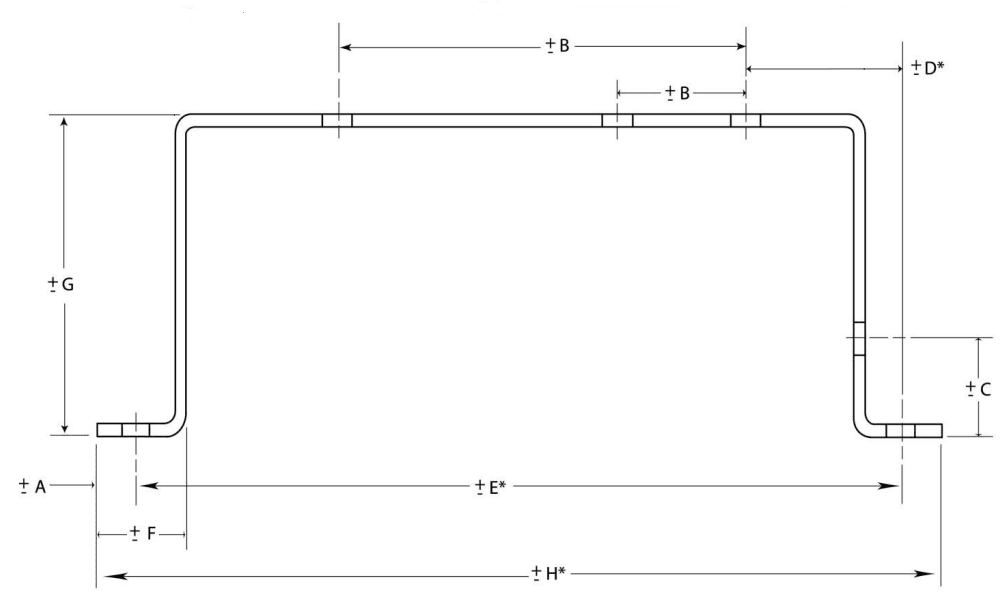
| DIM | Tolerance (MM) | Tolerance (Inches) | Description |
| A | ± 0.13 | ± 0.005 | Sheared Edge to Hole |
| B | ± 0.13 | ± 0.005 | 2 Holes on One Surface |
| C | ± 0.25 | ± 0.010 | Formed Edge to Hole |
| D* | ± 0.76 | ± 0.030 | Holes Across 2 Bends |
| E* | ± 0.76 | ± 0.030 | Holes Across 4 Bends |
| F | ± 0.25 | ± 0.010 | Sheared Edge to Bend |
| G | ± 0.38 | ± 0.015 | Across 2 Bends |
| H* | ± 0.76 | ± 0.030 | Formed Part |
Noted dimensions are to be taken while the part is in a restrained condition. Noted dimensions are for parts within a 12” envelope.
* Dimensions D, E and H are not recommended forms of dimensioning
These tolerances are recommended and best practices. We can obtain tighter tolerances (depending on part geometry/ construction), contact us for more information


