Last updated on February 18th, 2026 at 10:54 am
Not all metal fabrication shops have extensive expertise in welding and riveting. But at Approved Sheet Metal, we know both techniques inside and out and have plenty of experience helping customers choose between these two excellent methods for joining custom sheet metal parts.
Let’s explore welding and riveting in detail so you know which one to pick when planning your next sheet metal fabrication project.
Quick Decision Guide: Welding vs. Riveting
If you need a fast answer, here is a practical breakdown to guide your decision:
- Maximum strength or load-bearing structure? Choose welding.
- Watertight or airtight seam required? Choose welding.
- Lowest cost and fastest assembly? Choose riveting.
- Heat-sensitive material like thin aluminum? Riveting may reduce distortion risk.
- Need future disassembly or service access? Riveting is often preferable.
- High cosmetic requirement with seamless appearance? Welding typically provides a cleaner look.
What Is Welding in Custom Sheet Metal Fabrication?
Welding is a joining method that uses heat to fuse two or more pieces of sheet metal, sometimes using a filler rod. The process requires a high level of skill and careful control of heat input, especially on thin gauge materials.
We offer many different types of welding at ASM, including:
- Spot welding: Creates a permanent weld using pressure and heat from copper electrodes. Common for overlapping sheet metal.
- Tack welding: A low-heat, temporary welding method that fuses pieces together with small amounts of weld before final joining.
- Fuse welding: A permanent method in which sheet metal pieces are heated until they fuse together, with or without a filler rod.
- Stitch welding: Weld is applied along short, spaced sections between two parts, usually with a filler rod to manage distortion.
- Seam/fillet welding: Creates a continuous seam using a filler rod for structural and sealed joints.
- Metal inert gas (MIG) welding: An arc welding method that uses a solid wire electrode to join two pieces together efficiently.
- Tungsten inert gas (TIG) welding: An arc welding method that uses non-consumable tungsten to weld precision parts with high cosmetic quality.
What Is Riveting in Custom Sheet Metal Fabrication?
Riveting is a joining method that uses mechanical fasteners, or rivets, to connect two pieces together. Typically, a rivet consists of a round head connected to a tail; the tail is deformed after insertion to hold the rivet in place.
The most commonly used rivets are pop rivets or blind rivets, which can be installed even when only one side of the desired seam is accessible.
Welding vs. Riveting: Side-by-Side Comparison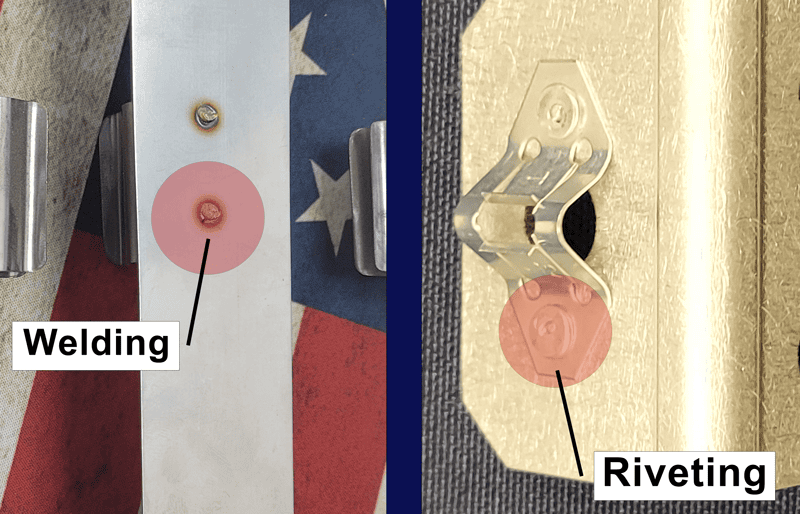
| Factor | Welding | Riveting |
|---|---|---|
| Strength | Very high, suitable for structural loads | Moderate, depends on rivet type and spacing |
| Watertight Seal | Yes, when properly executed | No, unless combined with sealants |
| Appearance | Clean, continuous seam possible | Visible fastener heads |
| Heat Distortion | Possible on thin or heat-sensitive materials | No heat distortion risk |
| Cost | Higher labor and skill cost | Generally lower cost |
| Speed | Slower for precision welds | Fast assembly |
| Disassembly | Permanent | Can be drilled out and replaced |
When to Choose Welding over Riveting
If consistency and aesthetic appearance are important for your part, welding is often the preferable option. Welding methods such as seam, MIG, and TIG welding create continuous seams that are visually clean. In comparison, seams created with rivets are more noticeable.
If your custom sheet metal parts need to be strong or watertight, welding is also the better choice. Frames, enclosures, tanks, and load-bearing assemblies benefit from welded seams because they provide higher structural integrity.
Welding Design Considerations
- Heat input must be controlled to avoid warping thin materials.
- Proper weld symbols and callouts on drawings prevent confusion.
- Cosmetic welds may require grinding or blending, which adds time and cost.
- Coated or plated materials may require post-weld refinishing.
When to Choose Riveting over Welding
When you have a tight budget or a short timeline, riveting can be the right solution. While the final result may not be as seamless visually, riveting is faster and often more cost-effective. For simple structures such as boxes or non-load-bearing enclosures, riveting is often a practical choice.
Riveting is also an excellent choice for sheet metal prototyping when you need to test a part’s performance quickly. There is always the option of transitioning to welding for final production if greater strength or aesthetics are required.
Another advantage is reduced distortion risk. When working with thin or heat-sensitive materials such as aluminum, riveting avoids the warping that can occur with welding.
Riveting Design Considerations
- Proper edge distance and spacing prevent tear-out.
- Grip range must match total material thickness.
- Structural rivets may be required for higher loads.
- Sealants may be necessary if moisture resistance is needed.
Hybrid Use of Welding and Riveting
In some projects, combining welding and riveting provides both strength and flexibility. Examples include:
- Welded Frames with Riveted Panels
- A welded structural frame supports the load, while riveted panels allow easier service access.
- Temporary Rivet Alignment Before Welding
- Rivets hold complex assemblies in place before final welds are applied.
- Dissimilar Materials
- Rivets join materials that cannot be welded together effectively.
- Prototyping to Production
- Riveting during prototype stages enables adjustments, with welding added for final strength.
ASM Is Your Go-To Partner for Welding and Riveting
At ASM, our team has over 20 years of experience welding and riveting custom sheet metal parts. We help customers balance strength, cost, appearance, and manufacturability to choose the right joining method for each application.
Looking for a metal fabrication shop you can count on? Request a quote to give us a shot on your next project!
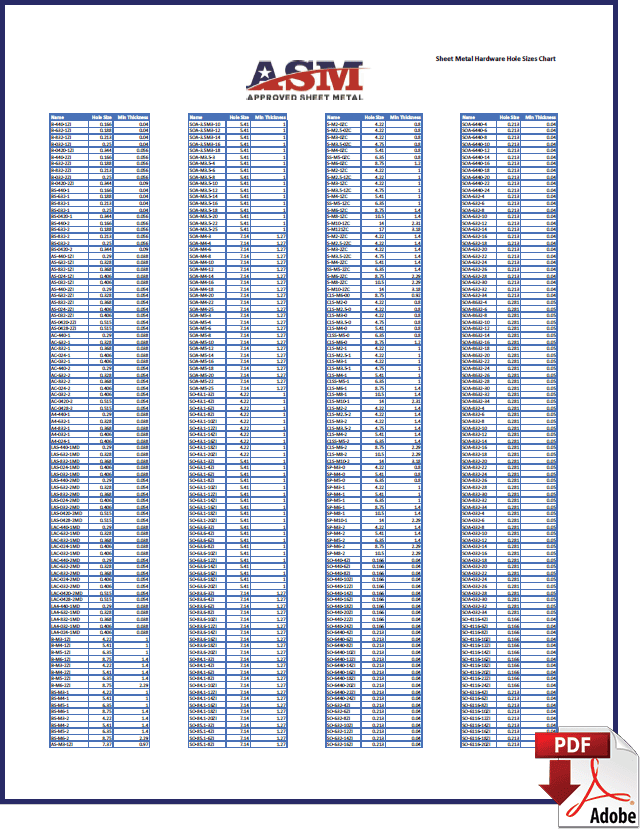
Sheet Metal Hardware Hole Sizes Chart
CHART DOWNLOAD
Hardware hole sizes are the number one thing sheet metal fabricators have to fix before sending a part to the floor. So we have created a referenceable chart for product developers that are designing sheet metal parts. Use this chart to find the correct hole size for the hardware you select.