
How to Create Sheet Metal Offsets without Custom Tooling
Last updated on August 17th, 2026 at 07:55 am
To determine whether you need dedicated offset tooling for your part, start with one important question: what is more important to the function of the part, the offset height or the offset angle?
If both the offset height and angle are critical dimensions, dedicated offset tooling may be the better manufacturing approach. If the offset height is critical but some variation in the resulting angle is acceptable, we can often achieve the bend you need by creating what's commonly called a “lazy offset.”
A lazy offset is a press brake forming technique that creates the required step or offset height without requiring the two bends to produce a strict 90-degree offset geometry. This makes it particularly useful for prototypes and low-volume parts where the height of the offset controls fit or clearance but the exact angle is secondary.
Here's how we approach lazy offsets at our precision metal fabrication shop:
Step 1: Select the appropriate tooling.
The offset height, material thickness, and required geometry determine the press brake tooling needed for the operation.
For our standard approach, we calculate the appropriate V opening size by multiplying the offset height by 1.414. We then select the appropriate available tooling using the tooling specifications.
Material type and thickness also matter because they affect forming force, springback, bend radius, and the final geometry of the offset.
Step 2: Set the press brake for the required offset height.
Rather than fully closing the tooling, the press brake is controlled to achieve the required offset height.
For example, if the design requires a .200" offset, we may be able to use a .250" die and control the forming depth rather than completely closing the tool. This allows us to produce a smaller offset using existing tooling.
At Approved Sheet Metal, our standard offset height tolerance is +/- 0.012", measured from the top of the sheet to the top of the formed offset. Our preferred offset radius is 0.030".
Step 3: Control the resulting offset geometry.
The forming operation is stopped at the depth required to produce the desired offset height. Because the tool is not necessarily being fully closed, the resulting angles may not be strict 90-degree bends.
That is the tradeoff that makes a lazy offset useful: we prioritize controlling the required offset height while allowing some flexibility in the offset angle.
For many brackets, chassis, panels, covers, and mating components, the offset height is what establishes the required clearance or position. In those applications, paying for dedicated tooling simply to achieve a more exact offset angle may not provide any functional benefit.
Here are the standard offset gaps you can use when designing your bends. The team at Approved Sheet Metal can also review the geometry and determine the best forming approach for your specific part.
What Tolerance Can We Hold on a Sheet Metal Offset?
At Approved Sheet Metal, our standard offset height tolerance is +/- 0.012", measured from the top of the sheet to the top of the formed offset. Our preferred offset radius is 0.030".
That tolerance applies to the height of the offset, not necessarily the angle created by a lazy offset. If the drawing requires both a tightly controlled height and tightly controlled bend angles, dedicated offset tooling may be required.
Material type, material thickness, offset height, part geometry, tooling access, and surrounding features can also affect the forming approach. Non-standard offsets may be possible, but they should be reviewed before production and may involve additional manufacturing cost.
How Does Material Thickness Affect an Offset Bend?
Material thickness is an important part of offset design because it affects the tooling, bend radius, forming force, springback, and achievable offset geometry.
The same offset should not automatically be carried from one material thickness to another without reviewing the design. An offset that works well in one gauge may require different tooling or geometry when the material becomes significantly thicker or thinner.
Material type matters as well. Aluminum, cold-rolled steel, and stainless steel have different forming characteristics and springback behavior, so the material specification should be considered along with the offset dimensions.
How Should an Offset Bend Be Dimensioned?
A clear drawing makes it much easier to determine whether an offset can be produced with standard tooling or requires a dedicated offset tool.
When an offset is functionally important, identify:
- Offset height: The vertical distance required between the two surfaces.
- Offset direction: Clearly show which direction the material needs to be formed.
- Critical angles: Identify the bend angles if they are functionally important rather than allowing them to be driven by the forming process.
- Radius: Specify a required radius only when it is important to the function of the part.
- Material and thickness: Both influence the tooling and forming behavior.
- Critical mating requirements: If the offset exists to provide clearance or locate another component, identifying that requirement can help us recommend the most manufacturable solution.
If offset height is the functional requirement and the exact angles are not critical, making that clear on the drawing may create an opportunity to use a lazy offset and avoid dedicated tooling.
When Does an Offset Bend Require Dedicated Tooling?
Dedicated offset tooling becomes more important when the complete geometry of the offset needs to be controlled, not just its height.
A dedicated tool may be the better choice when:
- Both offset height and bend angles are critical.
- The geometry cannot be produced reliably with available standard tooling.
- Repeatability of the complete offset geometry is particularly important.
- Production quantities justify the additional tooling investment.
Production volume alone does not determine whether custom tooling is required. Even a prototype may require dedicated tooling if its geometry cannot be produced another way. Conversely, a higher-volume part may still be a good candidate for a lazy offset if the design allows it.
Custom Offset Tooling vs. Lazy Offsets: Which One is Right for Your Part?
When designing a part with offset bends, the manufacturing decision generally comes down to the functional requirements of the offset. Dedicated tooling provides greater control over the complete geometry, while a lazy offset can use standard press brake tooling when height is more important than a strict offset angle.
Custom Offset Tooling
Custom or dedicated offset tooling is designed around a specific offset geometry and can create both bends in a controlled press brake operation.
Pros:
- Better control and repeatability of both offset height and angle.
- Efficient production once the dedicated tooling is available.
- Useful when the complete offset geometry is functionally critical.
- Can become economical when production quantities justify the tooling investment.
Cons:
- Additional tooling cost, which can have a significant impact on prototypes and low-volume orders.
- Longer lead times if tooling needs to be designed, ordered, or manufactured.
- Less flexibility because the tooling is intended for a particular range of offset geometry.
Lazy Offsets Using Standard Tooling
A lazy offset uses existing press brake tooling to achieve the required offset height while allowing more flexibility in the resulting bend angles.
Pros:
- No dedicated offset tooling may be required, making the approach particularly attractive for prototypes and low-to-medium volume production.
- Existing tooling can reduce both upfront cost and lead time.
- The forming setup can accommodate different offset heights within the capabilities of the available tooling.
- Works well when offset height is functionally critical but exact bend angles are not.
Cons:
- The resulting offset angles may vary more than with dedicated tooling.
- Setup and process control are important for maintaining the required offset height.
- Not the appropriate solution when both offset height and angle require tight control.
When to Choose Which Method
| Factor | Dedicated Offset Tooling | Lazy Offset |
|---|---|---|
| Offset Height | Tightly controlled | Designed to control the required height |
| Offset Angle | Better control of specified geometry | Some angle variation must be acceptable |
| Tooling Cost | Additional tooling investment | Typically uses existing tooling |
| Lead Time | May increase if tooling must be obtained | Faster when suitable tooling is already available |
| Flexibility | Designed around specific geometry | More adaptable to different offset heights |
| Best Fit | Height and angle are both critical | Height is critical and angle is secondary |
The Bottom Line
The decision between dedicated offset tooling and a lazy offset should be driven first by the functional requirements of the part.
If both the offset height and offset angle need tight control, dedicated tooling may be necessary regardless of production quantity. If offset height is the critical requirement and some angle variation is acceptable, a lazy offset can be a faster and more cost-effective approach, especially for prototypes and lower-volume production.
At Approved Sheet Metal, we can review the offset geometry, material, thickness, tolerances, and mating requirements to determine whether existing press brake tooling can produce the part or dedicated tooling is required.
Next time your part needs offset bends, send us the design and we'll help determine the most practical forming method. Request a quote today.
Sheet Metal Part Design for Manufacturing Tip
OFFSETS
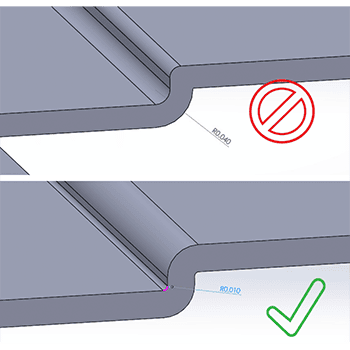
Offset height tolerance is +/- 0.012 in. top of sheet / top of form. The ideal offset radius is 0.030 in. Approved Sheet Metal can offer non-standard offsets to parts, but there will be additional costs associated.
How to Create Sheet Metal Offsets without Custom Tooling
To determine whether you need dedicated offset tooling for your part, start with one important question: what is more important to the function of the part, the offset height or the offset angle?
If both the offset height and angle are critical dimensions, dedicated offset tooling may be the better manufacturing approach. If the offset height is critical but some variation in the resulting angle is acceptable, we can often achieve the bend you need by creating what's commonly called a “lazy offset.”
A lazy offset is a press brake forming technique that creates the required step or offset height without requiring the two bends to produce a strict 90-degree offset geometry. This makes it particularly useful for prototypes and low-volume parts where the height of the offset controls fit or clearance but the exact angle is secondary.
Here's how we approach lazy offsets at our precision metal fabrication shop:
Step 1: Select the appropriate tooling.
The offset height, material thickness, and required geometry determine the press brake tooling needed for the operation.
For our standard approach, we calculate the appropriate V opening size by multiplying the offset height by 1.414. We then select the appropriate available tooling using the tooling specifications.
Material type and thickness also matter because they affect forming force, springback, bend radius, and the final geometry of the offset.
Step 2: Set the press brake for the required offset height.
Rather than fully closing the tooling, the press brake is controlled to achieve the required offset height.
For example, if the design requires a .200" offset, we may be able to use a .250" die and control the forming depth rather than completely closing the tool. This allows us to produce a smaller offset using existing tooling.
At Approved Sheet Metal, our standard offset height tolerance is +/- 0.012", measured from the top of the sheet to the top of the formed offset. Our preferred offset radius is 0.030".
Step 3: Control the resulting offset geometry.
The forming operation is stopped at the depth required to produce the desired offset height. Because the tool is not necessarily being fully closed, the resulting angles may not be strict 90-degree bends.
That is the tradeoff that makes a lazy offset useful: we prioritize controlling the required offset height while allowing some flexibility in the offset angle.
For many brackets, chassis, panels, covers, and mating components, the offset height is what establishes the required clearance or position. In those applications, paying for dedicated tooling simply to achieve a more exact offset angle may not provide any functional benefit.
Here are the standard offset gaps you can use when designing your bends. The team at Approved Sheet Metal can also review the geometry and determine the best forming approach for your specific part.
What Tolerance Can We Hold on a Sheet Metal Offset?
At Approved Sheet Metal, our standard offset height tolerance is +/- 0.012", measured from the top of the sheet to the top of the formed offset. Our preferred offset radius is 0.030".
That tolerance applies to the height of the offset, not necessarily the angle created by a lazy offset. If the drawing requires both a tightly controlled height and tightly controlled bend angles, dedicated offset tooling may be required.
Material type, material thickness, offset height, part geometry, tooling access, and surrounding features can also affect the forming approach. Non-standard offsets may be possible, but they should be reviewed before production and may involve additional manufacturing cost.
How Does Material Thickness Affect an Offset Bend?
Material thickness is an important part of offset design because it affects the tooling, bend radius, forming force, springback, and achievable offset geometry.
The same offset should not automatically be carried from one material thickness to another without reviewing the design. An offset that works well in one gauge may require different tooling or geometry when the material becomes significantly thicker or thinner.
Material type matters as well. Aluminum, cold-rolled steel, and stainless steel have different forming characteristics and springback behavior, so the material specification should be considered along with the offset dimensions.
How Should an Offset Bend Be Dimensioned?
A clear drawing makes it much easier to determine whether an offset can be produced with standard tooling or requires a dedicated offset tool.
When an offset is functionally important, identify:
- Offset height: The vertical distance required between the two surfaces.
- Offset direction: Clearly show which direction the material needs to be formed.
- Critical angles: Identify the bend angles if they are functionally important rather than allowing them to be driven by the forming process.
- Radius: Specify a required radius only when it is important to the function of the part.
- Material and thickness: Both influence the tooling and forming behavior.
- Critical mating requirements: If the offset exists to provide clearance or locate another component, identifying that requirement can help us recommend the most manufacturable solution.
If offset height is the functional requirement and the exact angles are not critical, making that clear on the drawing may create an opportunity to use a lazy offset and avoid dedicated tooling.
When Does an Offset Bend Require Dedicated Tooling?
Dedicated offset tooling becomes more important when the complete geometry of the offset needs to be controlled, not just its height.
A dedicated tool may be the better choice when:
- Both offset height and bend angles are critical.
- The geometry cannot be produced reliably with available standard tooling.
- Repeatability of the complete offset geometry is particularly important.
- Production quantities justify the additional tooling investment.
Production volume alone does not determine whether custom tooling is required. Even a prototype may require dedicated tooling if its geometry cannot be produced another way. Conversely, a higher-volume part may still be a good candidate for a lazy offset if the design allows it.
Custom Offset Tooling vs. Lazy Offsets: Which One is Right for Your Part?
When designing a part with offset bends, the manufacturing decision generally comes down to the functional requirements of the offset. Dedicated tooling provides greater control over the complete geometry, while a lazy offset can use standard press brake tooling when height is more important than a strict offset angle.
Custom Offset Tooling
Custom or dedicated offset tooling is designed around a specific offset geometry and can create both bends in a controlled press brake operation.
Pros:
- Better control and repeatability of both offset height and angle.
- Efficient production once the dedicated tooling is available.
- Useful when the complete offset geometry is functionally critical.
- Can become economical when production quantities justify the tooling investment.
Cons:
- Additional tooling cost, which can have a significant impact on prototypes and low-volume orders.
- Longer lead times if tooling needs to be designed, ordered, or manufactured.
- Less flexibility because the tooling is intended for a particular range of offset geometry.
Lazy Offsets Using Standard Tooling
A lazy offset uses existing press brake tooling to achieve the required offset height while allowing more flexibility in the resulting bend angles.
Pros:
- No dedicated offset tooling may be required, making the approach particularly attractive for prototypes and low-to-medium volume production.
- Existing tooling can reduce both upfront cost and lead time.
- The forming setup can accommodate different offset heights within the capabilities of the available tooling.
- Works well when offset height is functionally critical but exact bend angles are not.
Cons:
- The resulting offset angles may vary more than with dedicated tooling.
- Setup and process control are important for maintaining the required offset height.
- Not the appropriate solution when both offset height and angle require tight control.
When to Choose Which Method
| Factor | Dedicated Offset Tooling | Lazy Offset |
|---|---|---|
| Offset Height | Tightly controlled | Designed to control the required height |
| Offset Angle | Better control of specified geometry | Some angle variation must be acceptable |
| Tooling Cost | Additional tooling investment | Typically uses existing tooling |
| Lead Time | May increase if tooling must be obtained | Faster when suitable tooling is already available |
| Flexibility | Designed around specific geometry | More adaptable to different offset heights |
| Best Fit | Height and angle are both critical | Height is critical and angle is secondary |
The Bottom Line
The decision between dedicated offset tooling and a lazy offset should be driven first by the functional requirements of the part.
If both the offset height and offset angle need tight control, dedicated tooling may be necessary regardless of production quantity. If offset height is the critical requirement and some angle variation is acceptable, a lazy offset can be a faster and more cost-effective approach, especially for prototypes and lower-volume production.
At Approved Sheet Metal, we can review the offset geometry, material, thickness, tolerances, and mating requirements to determine whether existing press brake tooling can produce the part or dedicated tooling is required.
Next time your part needs offset bends, send us the design and we'll help determine the most practical forming method. Request a quote today.


