
Last updated on August 28th, 2026 at 09:48 am
When sourcing custom sheet metal parts, buyers may need more than finished components. Depending on the industry, drawing requirements, purchase order, and internal quality system, an order may also require material traceability, inspection documentation, certificates of conformance, outside-process certifications, or a fabricator with specific quality or regulatory credentials.
ISO 9001 certification, ITAR registration, material certifications, First Article Inspection Reports, inspection reports, and Certificates of Conformance serve different purposes. Understanding the difference helps buyers specify exactly what documentation their project requires before manufacturing begins.
| Quality Requirement | When to Request or Verify | What It Tells the Buyer |
|---|---|---|
| ISO 9001:2015 Certification | When your supplier qualification process requires an ISO-certified Quality Management System | Confirms the fabricator maintains a Quality Management System certified to ISO 9001:2015 |
| ITAR Registration | When sourcing work involving defense articles, technical data, or other export-controlled requirements subject to ITAR | Confirms the manufacturer is registered with the U.S. Department of State's Directorate of Defense Trade Controls |
| Material Certification | When material identity, specification, or traceability documentation is required | Provides documentation supporting the material grade, specification, heat or lot, and other material information as applicable |
| First Article Inspection (FAI) | When documented inspection of an initial production part or assembly is required | Documents specified characteristics against the applicable drawing and order requirements |
| Dimensional Inspection Report | When documented measurements are required for specific features or dimensions | Records measured results for the characteristics identified by the customer |
| Certificate of Conformance (CoC) | When required by the purchase order, customer quality system, or applicable contract requirements | Provides the supplier's certification that the delivered product conforms to the stated order requirements |
| Outside-Process Certification | When documentation is required for plating, anodizing, passivation, coating, or another outside process | Documents the applicable secondary process and specification as provided by the processor |
1. ISO 9001:2015 Certification
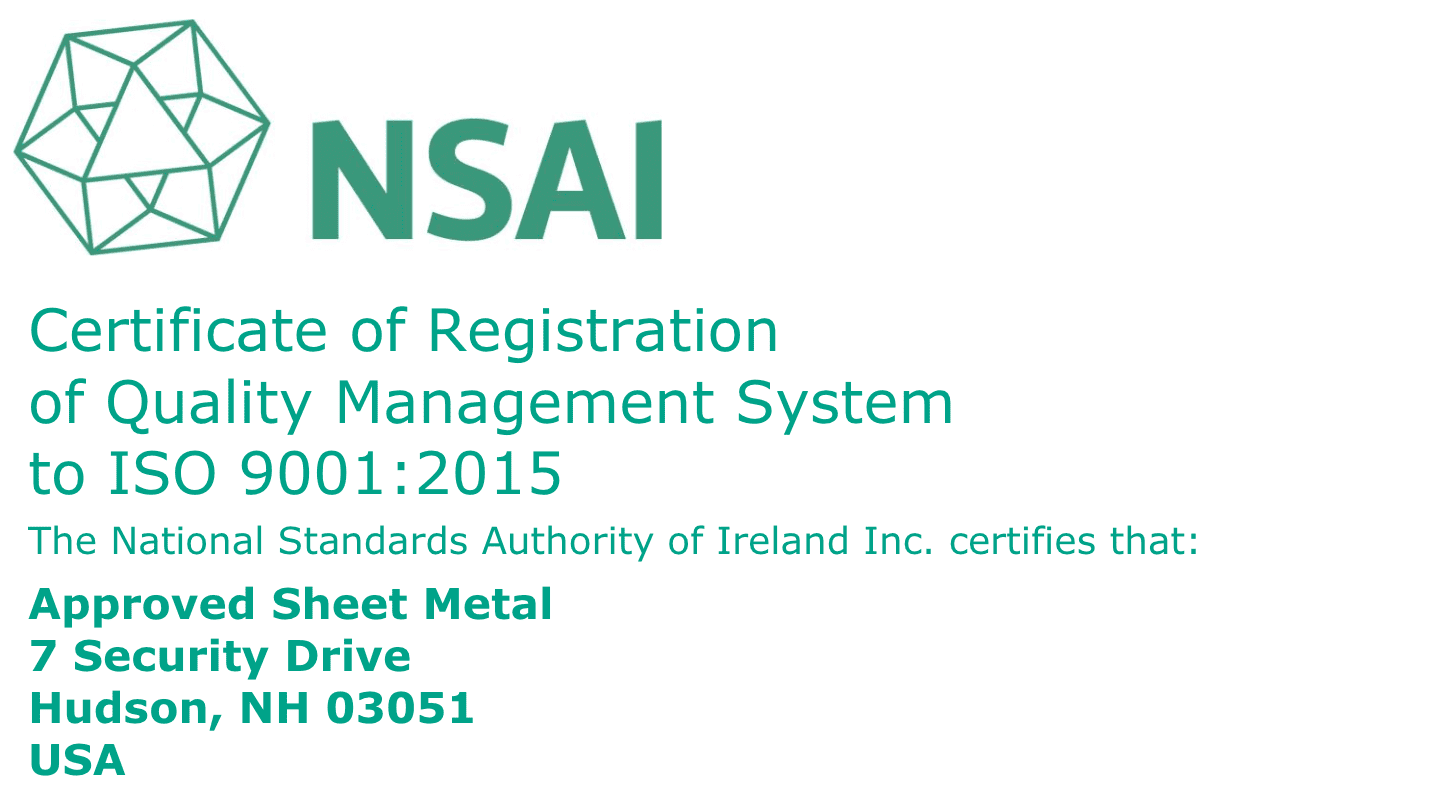
The bottom line: Approved Sheet Metal is ISO 9001:2015 certified, meaning our Quality Management System has been independently audited against the requirements of the ISO 9001 standard.
What is ISO 9001:2015?
The International Organization for Standardization, or ISO, develops international standards used across many industries.
ISO 9001 establishes requirements for a Quality Management System, or QMS. A QMS provides a structured framework for controlling processes that affect product and service quality.
ISO 9001 certification does not mean that every individual part is automatically certified or that a supplier is qualified for every regulated application. It means the organization's Quality Management System has been audited and certified against the requirements of the standard.
How does ISO 9001:2015 benefit sheet metal buyers?
ASM's Quality Management System provides documented processes for areas that can include:
- Document and record control
- Customer requirements
- Supplier controls
- Inspection and measurement
- Calibration
- Control of nonconforming product
- Corrective action
- Internal auditing
- Continuous improvement
For buyers, ISO 9001:2015 certification provides independent confirmation that ASM maintains a structured quality system rather than relying solely on informal shop practices.
View ASM's ISO 9001:2015 Certificate
2. ITAR Registration
The bottom line: Approved Sheet Metal is registered with the U.S. Department of State's Directorate of Defense Trade Controls (DDTC). This is important for customers whose projects involve defense articles, technical data, or other export-controlled information subject to the International Traffic in Arms Regulations (ITAR).
What is ITAR?
ITAR stands for International Traffic in Arms Regulations. These U.S. export-control regulations govern certain defense articles, defense services, and related technical data.
Manufacturers working with ITAR-controlled projects may have specific requirements for how controlled items and technical data are received, accessed, stored, handled, transferred, and shared.
ASM maintains an ITAR compliance program and is registered with DDTC.
DDTC registration should not be confused with a government certification, endorsement, or approval of a manufacturer. Customers remain responsible for identifying the export-control requirements that apply to their specific project.
How does ITAR registration benefit buyers?
For buyers sourcing export-controlled defense work, a supplier's DDTC registration can be an important qualification requirement.
If your RFQ contains ITAR-controlled technical data or has specific handling requirements, identify those requirements when submitting the project so they can be handled appropriately from the beginning.
3. Material Certifications and Traceability
The bottom line: A material certification provides documentation about the raw material supplied for the job and can support traceability to the material source, heat, lot, specification, or other identifying information depending on the material and documentation provided.
A material certification does not determine whether the engineer selected the correct material for the application. Instead, it provides documentation supporting what material was supplied.
What is a material certification?
Depending on the industry and material, buyers may hear terms such as material certification, Material Test Report (MTR), Mill Test Report, or Mill Test Certificate (MTC).
The exact format and information provided varies by material, mill, distributor, and specification.
Depending on the material and documentation, a material certification may include:
- Material alloy or grade
- Temper or condition
- Heat or lot number
- Applicable ASTM, AMS, or other material specification
- Chemical composition
- Mechanical properties
- Test results
- Mill or manufacturer information
Why does material traceability matter?
The primary value to the buyer is documentation and traceability.
If the drawing or purchase order requires a specific alloy, temper, material specification, or level of traceability, the applicable material documentation helps support that requirement.
This can be particularly important for aerospace, defense, medical, and other applications with formal material-control requirements.
If material certifications are required, identify that requirement during the RFQ process rather than after the parts have already been manufactured.
4. First Article Inspection
The bottom line: A First Article Inspection, or FAI, verifies and documents specified characteristics of an initial production part or assembly against the applicable drawing and purchase-order requirements.
What is a First Article Inspection?
An FAI provides documented evidence of inspection results for the characteristics required by the customer.
The exact scope of an FAI depends on the customer's requirements. It may involve dimensional characteristics, material documentation, special processes, hardware, finishes, or other requirements identified by the drawing and purchase order.
If your organization requires a specific FAI format or standard, identify it when requesting the quote. For example, an aerospace customer requiring an AS9102 First Article Inspection should specifically call out that requirement rather than simply requesting an “FAI.”
When should you request an FAI?
An FAI may be requested for an initial production run, a new part, or after certain design, process, supplier, tooling, or manufacturing changes, depending on the customer's quality requirements.
Do not assume an FAI will automatically be included with an order. If one is required, specify it on the RFQ and purchase order.
FAI vs. first part sample
These terms are sometimes used interchangeably, but they can represent very different requirements.
- FAI: You need documented inspection results against specified requirements.
- First part sample: You want an initial manufactured part to evaluate or inspect internally before proceeding with the remaining quantity.
If you require an FAI, provide ASM with your fully dimensioned 2D fabrication drawing along with the 3D model and clearly identify the required inspection format and documentation.
5. Dimensional Inspection Reports
Not every project that requires documented inspection needs a full First Article Inspection.
A customer may instead require a dimensional inspection report documenting measurements for specific characteristics on the drawing.
Depending on the project, the requirement might include:
- Inspection of specific critical dimensions
- Documented results for identified drawing characteristics
- Inspection of a defined sample quantity
- 100% inspection of specified features
- Customer-specific inspection forms
The important point is to define the requirement before production.
If only five dimensions need documented results, identify those five dimensions. If every drawing characteristic needs to be reported, identify that requirement as well.
Clear inspection requirements allow the fabricator to quote the appropriate inspection time and documentation rather than guessing what the customer expects.
6. Certificate of Conformance
The bottom line: A Certificate of Conformance, commonly called a CoC, is a supplier-issued document certifying that the delivered product conforms to the requirements identified by the purchase order, drawing, specifications, or other applicable documentation.
You may also hear terms such as Certificate of Conformity or Certificate of Compliance depending on the customer's terminology and quality system.
What information is included on a CoC?
The exact content varies by customer and contractual requirements, but a CoC may identify information such as:
- Supplier
- Customer
- Purchase order number
- Part number
- Part revision
- Quantity
- Applicable specifications
- Statement of conformance
- Authorized signature or approval
- Date
A CoC does not inherently require a First Article Inspection, nor is it necessarily a dimensional inspection report.
If your quality system requires a CoC with every shipment, identify that requirement on the RFQ and purchase order.
7. Outside-Process Certifications
Custom sheet metal fabrication frequently includes secondary processes performed after cutting, forming, welding, or hardware installation.
Depending on the project, these processes may include:
- Powder coating
- Anodizing
- Chromate conversion coating
- Zinc plating
- Passivation
- Electroless nickel plating
- Electropolishing
- Other customer-specified finishing processes
If the drawing requires a controlled finishing specification, the customer may also require certification from the processor documenting that the operation was performed to the specified requirement.
Do not assume that requesting a particular finish automatically means every available processor certification will be included with the shipment. If outside-process certifications are required, identify that requirement during quoting.
Specify Quality Documentation Before You Order
One of the most important things a buyer can do is define quality and documentation requirements before the parts are manufactured.
Inspection reports, material traceability, special-process certifications, FAIs, and customer-specific quality documentation can require additional inspection, recordkeeping, supplier coordination, and administrative work.
Requesting documentation after manufacturing is complete can create problems if the required records or traceability were not established when the material was purchased or the parts were processed.
Quality Documentation Checklist for Sheet Metal Buyers
Before submitting an RFQ or purchase order, determine whether your project requires:
- ISO 9001:2015-certified supplier
- ITAR-registered supplier
- Material certifications
- Heat or lot traceability
- Certificate of Conformance
- First Article Inspection
- AS9102 FAI specifically
- Dimensional inspection report
- Specific dimensions or characteristics to be reported
- 100% inspection of specified characteristics
- Outside-process certifications
- Finish or plating certifications
- Part serialization
- Special labeling or packaging
- Customer-specific quality clauses
Include these requirements with the RFQ whenever possible. That allows ASM to review the complete quality requirement, account for the necessary inspection and documentation, and provide an accurate quote.
Quality Documentation Starts with a Clear RFQ
Approved Sheet Metal is ISO 9001:2015 certified and ITAR registered, and our team works with customers that require material traceability, inspection documentation, Certificates of Conformance, First Article Inspections, and secondary-process documentation.
The key is making those requirements clear before production begins.
When requesting a quote, provide the 3D model, fully dimensioned 2D drawing, applicable specifications, inspection requirements, and quality clauses associated with the project.
That gives our estimating, manufacturing, and quality teams the information needed to evaluate the complete job rather than discovering additional documentation requirements after the parts have been produced.


