
Last updated on August 28th, 2026 at 09:31 am
At Approved Sheet Metal, we like to help our customers save time and money on custom metal fabrications whenever possible.
Material utilization is one of the easiest ways to reduce the cost of a sheet metal part. Small changes to part size, orientation, quantity, or sheet size can sometimes allow more parts to fit on each sheet, reducing both material cost and scrap.
Here are a few practical ways engineers and buyers can improve sheet metal material utilization before sending a project out for quote.
How to Get the Most Out of Sheet Metal Material
1. Design Around Common Sheet Sizes When Practical
When engineers know the standard sheet sizes commonly available, they can sometimes make small, non-critical design changes that allow more parts to fit on each sheet.
Common sheet sizes available through Approved Sheet Metal include:
- 48” x 48”
- 36” x 96”
- 48” x 96”
- 36” x 120”
- 48” x 120”
For same-day flat parts, 48” x 48” is the standard sheet size.
Larger or less common sheet sizes may also be available depending on the material, thickness, supplier availability, and lead time, but non-standard stock can increase material cost or sourcing time.
If your part is close to a breakpoint where two, three, or four parts could fit on a standard sheet, even a small change in a non-critical overall dimension may improve material utilization.
However, engineers do not need to create the final production nest themselves. ASM’s nesting software determines the actual sheet layout based on the part geometry, material, thickness, machine requirements, edge conditions, quantity, and other manufacturing considerations.
The examples below show why part dimensions can have a major effect on how efficiently components fit onto a sheet.
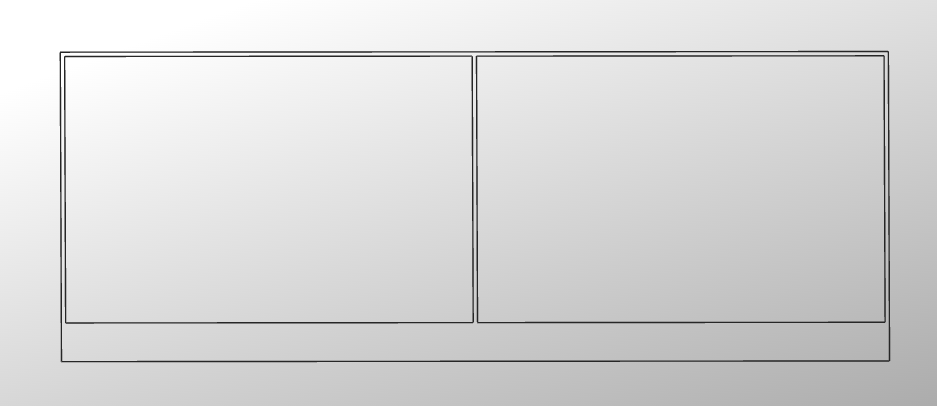
A relatively small dimensional change can sometimes allow an additional part to fit within the available sheet area.
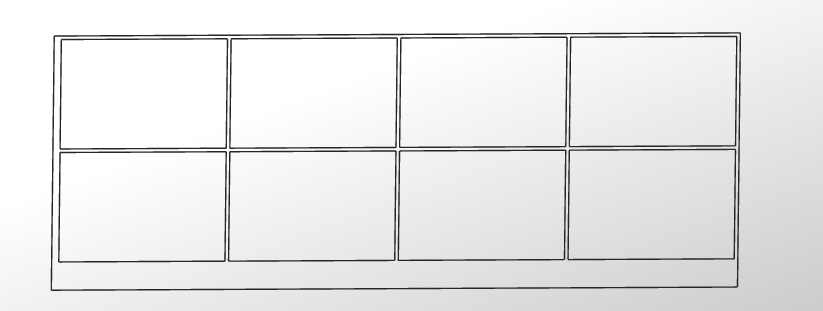
This becomes even more important as quantities increase because a more efficient nest can reduce the number of full sheets required for the job.
2. Pair Large and Small Parts When They Use the Same Material
Another way to improve material utilization is to nest different part sizes together when getting a quote for custom metal fabrications.
For example, a large panel may leave an area of usable material along one edge of the sheet that is too small for another large panel but large enough for brackets, covers, or other smaller components.
This works best when the parts use the same:
- Material type
- Material thickness
- Material condition or finish
- Compatible cutting requirements
If several parts from the same project meet those requirements, send them together in the RFQ. ASM can evaluate whether they can be nested efficiently on the same sheet.
3. Consider Alternate Sheet Sizes
Standard sheet sizes are convenient, but they are not always the most economical option for every job.
For some projects, ASM may be able to source a different sheet width or length that produces better material yield.
For example, we previously sourced a 36” x 120” sheet for a customer who needed a 31.45” x 39.125” part. Using a wider 48” x 120” sheet would have created significantly more unused material.
In that case, the alternate sheet size reduced waste and lowered material cost.
Whether a custom or less-common sheet size actually saves money depends on factors such as:
- Material availability
- Supplier pricing
- Minimum purchase quantities
- Required quantity
- Lead time
- Freight or sourcing costs
That is why it is usually better to let your fabricator compare the options rather than assuming the smallest possible sheet will always be the least expensive.
4. Let the Nesting Software Optimize Part Orientation
Part orientation can also affect sheet utilization.
Some components can be rotated 90 degrees, alternated, or nested around one another to make better use of the available sheet area.
However, orientation is not always flexible. Restrictions may include:
- Cosmetic grain direction
- Brushed stainless grain direction
- Material grain and forming requirements
- Pre-finished material
- Directional surface requirements
If orientation is important to the finished part, clearly identify it on the drawing. If it is not important, allowing the nesting software more freedom may improve material yield.
5. Consider How Quantity Affects Material Yield
Material utilization is not simply a calculation of part area divided by sheet area.
The number of parts being ordered can change the most efficient nest.
For example, a particular sheet might efficiently produce two parts, while ordering three parts requires purchasing a second sheet with a significant amount of unused material. A slightly higher quantity may sometimes utilize that additional sheet much more efficiently.
This does not mean you should order parts you do not need, but if your required quantity is flexible, it can be useful to ask whether nearby quantity breaks improve material utilization or piece price.
Common Opportunities to Reduce Sheet Metal Material Waste
| Design Situation | Potential Opportunity |
|---|---|
| Part is slightly larger than half of a common sheet dimension | Review whether a non-critical overall dimension can be reduced |
| Large unused area remains next to a part | Nest compatible smaller parts in the remaining area |
| Part uses only a portion of standard stock | Ask whether an alternate sheet size is economically available |
| Part can be rotated without affecting function | Allow nesting software to optimize orientation |
| Order quantity is flexible | Compare nearby quantities for more efficient sheet utilization |
| Grain or cosmetic direction matters | Clearly identify the required orientation on the drawing |
Don’t Optimize Material at the Expense of the Part
Improving material utilization can reduce cost, but it should never compromise the form, fit, or function of the finished component.
Do not reduce a critical flange, move an important hole, change a required clearance, or alter a functional overall dimension simply to fit another part onto a sheet.
Likewise, changing material or thickness to improve sheet yield can affect forming behavior, strength, weight, hardware compatibility, and finishing requirements.
Material and Thickness Affect Formability
Different alloys and tempers behave differently during bending.
For example, 5052-H32 aluminum is generally much more suitable for tight forming than 6061-T6. A part that forms easily in one aluminum alloy may require a significantly larger bend radius in another.
The appropriate bend radius depends on factors including:
- Material alloy
- Material temper
- Thickness
- Grain direction
- Tooling
- Forming method
For that reason, avoid using one universal bend-radius multiple for all aluminum, stainless steel, or steel parts.
Grain Direction Can Limit Nesting Orientation
Material grain direction can be important when forming certain sheet metals, especially aluminum.
Bending perpendicular to the material grain generally reduces the risk of cracking compared with bending parallel to the grain, particularly in less ductile alloys or tight bends.
Cosmetic materials can create another restriction. For brushed or grained stainless steel, adjacent components may need a consistent visible grain direction even if rotating one part would improve sheet utilization.
When grain direction matters, identify it clearly on the drawing so ASM can balance forming or cosmetic requirements with the most efficient possible nest.
Springback Changes with Material
Changing alloy, temper, or thickness can also change the amount of springback that occurs during forming.
Springback is the tendency of sheet metal to partially return toward its original shape after the forming load is removed. The amount varies with material properties, bend geometry, and forming method.
Your fabricator compensates for springback through tooling, bend calculations, and forming setup, so it generally should not be addressed by arbitrarily changing the CAD geometry.
Let Your Fabricator Optimize the Sheet
You do not need to engineer the production nest before requesting a quote.
The most helpful thing you can do is provide ASM with complete part information, realistic quantities, and any design constraints that affect orientation or material selection.
If you have flexibility in a non-critical dimension, sheet size, quantity, or material option, let us know. We can evaluate whether that flexibility creates an opportunity to improve material utilization without affecting the function of the part.
We’re happy to help customers find practical ways to reduce material waste and manufacturing cost. Give us a shot on your next project.
Recommended Default Sheet Metal Tolerances
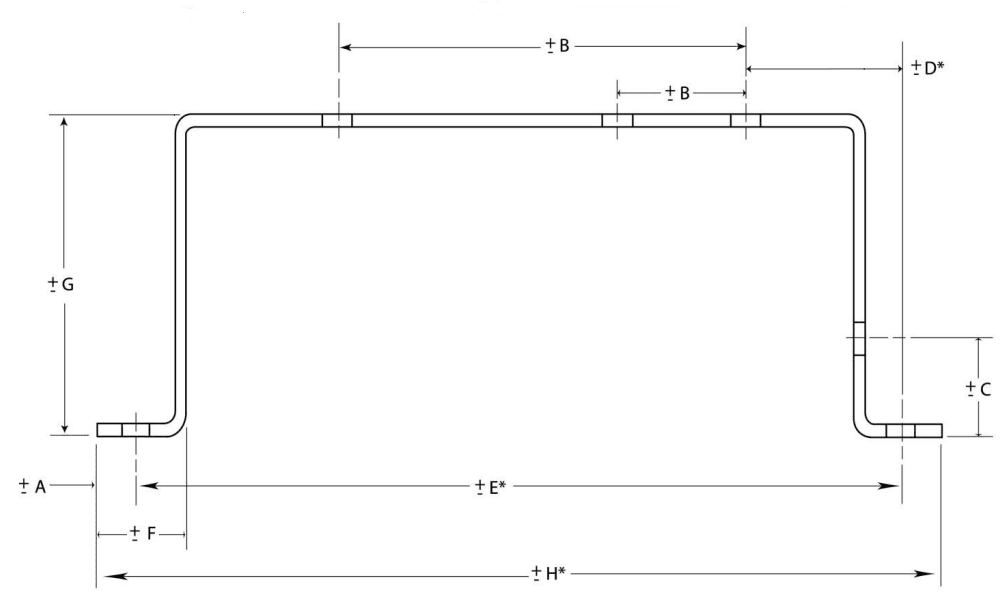
| DIM | Tolerance (MM) | Tolerance (Inches) | Description |
| A | ± 0.13 | ± 0.005 | Sheared Edge to Hole |
| B | ± 0.13 | ± 0.005 | 2 Holes on One Surface |
| C | ± 0.25 | ± 0.010 | Formed Edge to Hole |
| D* | ± 0.76 | ± 0.030 | Holes Across 2 Bends |
| E* | ± 0.76 | ± 0.030 | Holes Across 4 Bends |
| F | ± 0.25 | ± 0.010 | Sheared Edge to Bend |
| G | ± 0.38 | ± 0.015 | Across 2 Bends |
| H* | ± 0.76 | ± 0.030 | Formed Part |
Noted dimensions are to be taken while the part is in a restrained condition. Noted dimensions are for parts within a 12” envelope.
* Dimensions D, E and H are not recommended forms of dimensioning
These tolerances are recommended and best practices. We can obtain tighter tolerances (depending on part geometry/ construction), contact us for more information


